Teejop was once home to a flourishing community that created thousands of mounds, and we are the caretakers of those that remain.

OLBRICH
PARK


Spring Harbor &
Merrill Springs
Everywhere you go in Teejop, mounds stand or once stood. These magnificent structures take many forms, including geometric shapes such as lines and cones, and the effigies of animals and spirits. These were mainly built between 900 and 1300 years ago, as resting places for the bodies of the honored dead, and they remained largely undisturbed until the American settlement of the region. Ho-Chunk villages and camps flourished beside them, and Ho-Chunk people explained to early settlers that they were part of their patrimony. Many represent creatures that are part of the Ho-Chunk clan system.
Since the 1830s the great majority of Teejop’s mounds have been destroyed by farming or construction, everywhere from the ground of the capitol and university to private homes and fields. The ones that remain are priceless and irreplaceable testaments to their builders, the people interred within them, and the generations upon generations who have cared for them. Today, we are the ones who must sustain that legacy.
Questions
What are mounds?
Where are the mounds?
How does your family/culture care for the dead?
How do different peoples care for the dead?
What are the different ways Indigneous peoples care for the dead?
What are our responsibilities to the dead?
Do the dead have rights?
How is Teejop unique?
What happened to the mounds here?
How do Ho-Chunk people care for the mounds?
How are Indigenous peoples caring for the mounds?
What are recent controversies about the mounds?
How are non-Indigenous peoples caring for the mounds?
What is the Native American Graves Protection and Repatriation Act (NAGPRA)?
Is it important to talk about death?
Why is it important to talk about death?
How are death and life interconnected?
What does it mean to be a caretaker?
Do you have a caretaker?
Are you a caretaker?
What does a caretaker do?
What are we caretakers of together?
[I have included accounts of 19th/early 20th-century burial grounds in the Olbrich/Hudson area in case we want to link the mounds to more recent Ho-Chunk practices]
John Blackhawk, “The Winnebago Indians and the Mounds,” 1929 (Brown Papers Box 3, folder 4)
Mounds were built in response to visions. Gives an account of the vision of “a noted chief, Ho-min-ka,” whose village was near or where Madison lies, of “an immense buffalo” who arose out of a lake in a mist and blessed the village, bringing it seven years of prosperity and no death. Speculates that a mound was built in response.
“Fair Oaks Winnebago Indian Camp Sites” (Brown Papers Box 22, Folder 2)
19th-century burying ground on elevation of current Elmside Boulevard
“Lake Monona - Madison Wisconsin” (Brown Papers Box 22, Folder 2)
(Walterscheit farm, across the Starkweather Creek from the current Garver Feed Mill) “Opposite this farm on the lake ridge … was their cemetery … They buried their dead in graves three or four feet in depth and included with the burials some of the possessions of the deceased.” [I think this refers to a site in Olbrich Park adjacent to the current East Side Club]
p. 10 Wilson St. & Wisconsin Ave. mounds
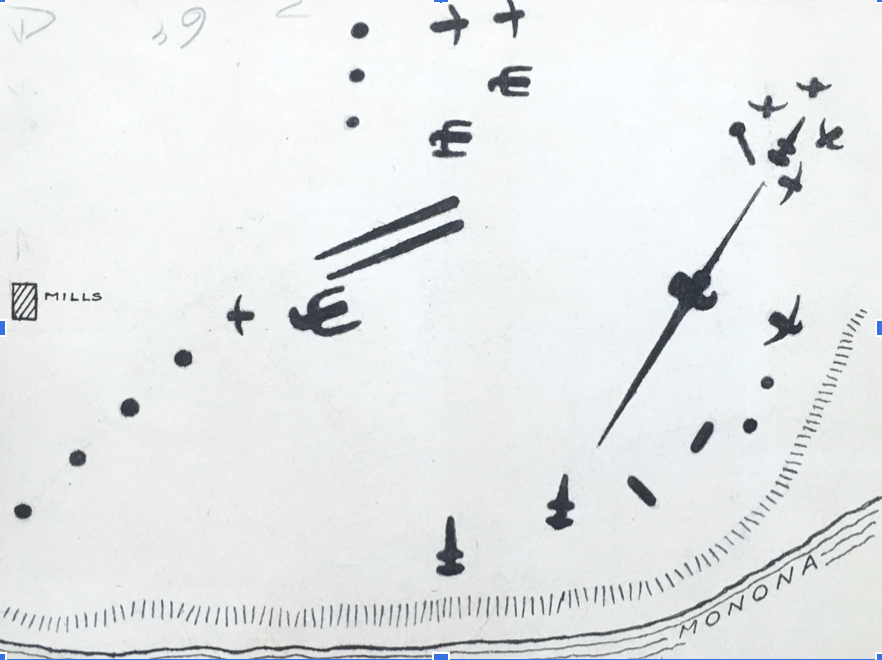
Stephen Peet drawing of Olbrich/Hudson Park mound group, 19th century (Brown Papers Box 22 F 2)
References